


For financial advisers and professional investors only – not for distribution to retail investors.
4 December 2025
By Brett Lewthwaite
Reflecting on our recent Strategic Forum discussions, it is over a year since we first identified the gradual - and then sudden - shift toward ‘national priorities’. Our previous note, ‘An erosion of trust in an era of national policy musts?’, proved prescient and worthy of pre-reading. The two dominant themes highlighted in this note have increasingly captured the focus and attention of financial market participants throughout 2025 and are expected to remain central to the outlook for the year ahead. These two themes, that intertwine at several important junctures, are:
- The shift to national priorities. This theme has recently encountered some stark realities, and in doing so has revealed some acute vulnerabilities, that are accelerating the shift even further. We maintain that these initiatives and their components are all ‘need to’, not ‘want to’ priorities. In our view, nations that neglect these priorities risk falling behind in a rapidly evolving global order.
- The Artificial Intelligence transformational revolution. Is this an incredible boom, a sizable financial market bubble or both? The answer to which will only be accelerated by the link to ‘passive is massive’. Similarly to the first dominant theme, this is a ‘need to’, rather than ‘want to’ priority for national policymakers. This sentiment is captured in our AI influenced title to this note.
This period of profound adjustment and transformation is marked by a focus on national priorities, intertwined with the drive to keep pace, if not outright lead, the AI technological revolution. This environment lends itself to leaders and policymakers leveraging all available tools, including not only significant fiscal policy initiatives but also, where possible, monetary policy settings, to sponsor greater national progress. The priorities span national security (military), energy security (old, new and even nuclear), food, medical and essential inputs (including rare earths) security, technological advancements including AI, and all the logistics and infrastructure (power, data, roads, ports) required to support this.

You may call it industrial policy, friendshoring, or de-risking. It adds up to the same thing: state-directed investment”
- Russell Napier
Equally, policymakers are increasingly inclined to respond quickly to adverse developments, such as economic recessions, that could temper the required national progress. In other words, there are genuine ‘need to’ reasons for national policymakers to seek to ‘run it hot’ when it comes to their respective economies. The US is at the forefront of this shift, and in undertaking this, by default other nations are forced to follow.
The accelerating shift toward national interests and priorities
Since our last note, that highlighted the initiatives and breaking of established norms most obvious in the US administration’s declaration of ‘Liberation Day’, we have witnessed further significant shifts. These include the erosion of the central bank’s (the ‘Fed’) long held independence, continued tariff volatility (with little progress relating to China in particular), and subsequent adjustments in varying financial markets, most notably the significant move higher in the price of gold.
Interestingly, while Liberation Day’s original intention appeared to both directly and indirectly curb China’s global economic advantages and progress, China held its ground, leading to a series of 90-day trade negotiation extensions. It has since become clear that all is not as simple as it first seemed. China seemingly has a lot more leverage in negotiations than many had first assumed. China also appears to have advanced considerably in technology and AI, now leading in several areas. China’s position on the production of rare earths has revealed considerable vulnerabilities in Western economies’ supply chains and China has proven it isn’t afraid to exploit this position.
Upon reflection, very few countries have negotiated deals with the US, and those that have are primarily allies. Most of these took the form of opaque memorandums in exchange for (military) security or commitments to invest in the US. More recently, negotiations with China have progressed (or arguably delayed) given the realisation that China holds tight supply of critical rare earths and other key inputs. Given these vulnerabilities along with declining voter polls in the US, our view is that trade tensions have peaked, with further de-escalation likely. Nonetheless, this greater comprehension of the reliance on China will only serve to accelerate the shift toward national priorities, with the US and the West seeking to reduce, if not outright remove, vulnerabilities. China, facing its own weaknesses, most notably energy security, will similarly accelerate initiatives such as nuclear power to address these fragilities. As such, the pursuit of national interests is even more pronounced, underscoring a resultant shift to (significant) fiscal support.
While this significant shift is expected to support medium-term economic growth, considerable questions remain regarding how it will all be funded. Looking back, Liberation Day’s greatest achievement may have been little more than shining a light on these realities, and in doing so, inadvertently highlighting the, already very challenged, debt trajectories of Western sovereigns, including the US.
So, how will unsustainable debt trajectories be managed and funded? This question is poised to play a role in shaping financial markets, at least episodically in the investible time frame we are focused on.
Yellenomics and unsustainable debt trajectories. Computer says…No.
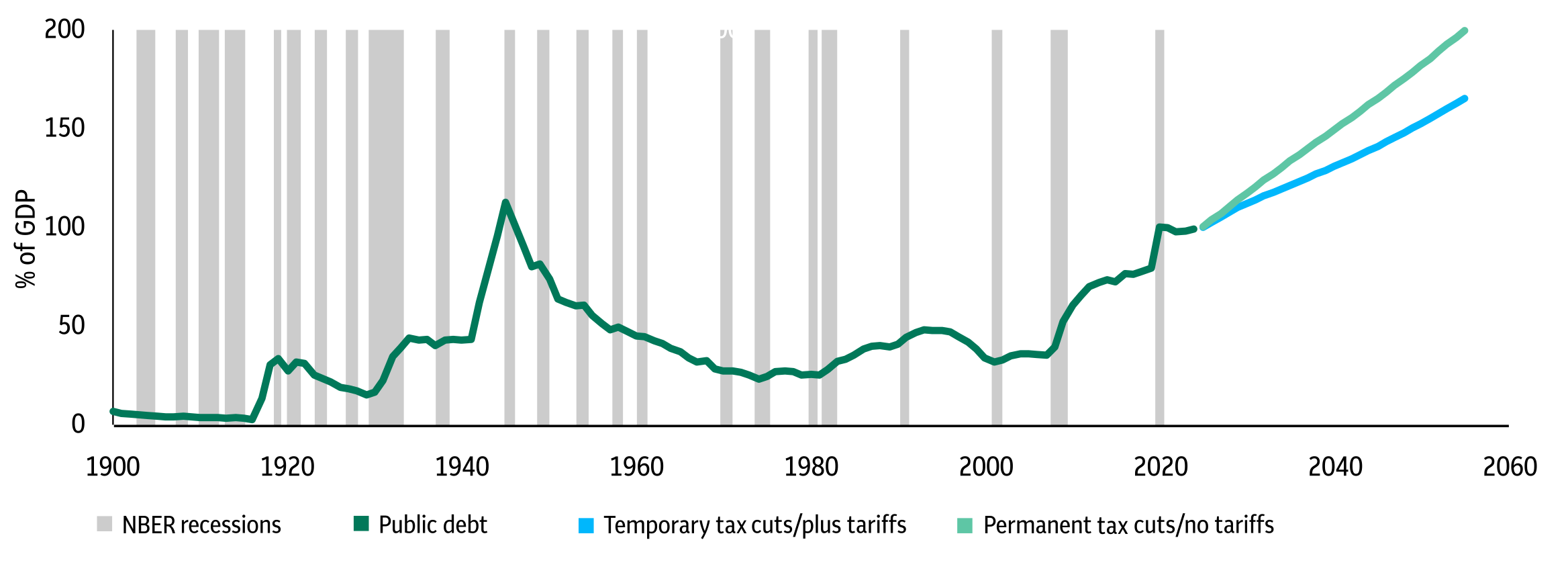
The challenging starting fiscal position of many leading economies is now common knowledge. Four decades of monetary policy dominance including the remedying of several crises such as the Global Financial Crisis and COVID pandemic, has resulted in elevated sovereign debt levels that continue to grow rapidly.
The US, with an annual fiscal deficit of 6-7% p.a. of GDP, is a clear example of this. Awareness of the debt trajectory as well as other geo-political tensions (such as the seizure of Russian reserves and Liberation Day) has gradually seen US debt holders change markedly. Previously, many large nations like China and Russia held US treasuries as reserve assets. Today, we find the largest holders increasingly taking the form of short-term money market funds, holding T-Bills rather than long term treasuries, as well as less permanent or ‘hotter’ money, such as hedge funds domiciled in places like the Cayman Islands. We refer to this increasing reliance on shorter-dated funding as ‘Yellenomics’, a trend that began under Janet Yellen and has continued under the new administration. This situation is further accentuated by both the prevailing yield environment, escalating interest payments, and the trajectory of ‘boomer’ entitlements, projected to climb steeply. While this is already a very challenging position, the addition of ‘need to’ based national priorities makes it ever more so, prompting the questions – how will the US debt burden be managed?
Figure 1:
Even the most optimistic forecasts are challenged: US budget balance/GDP
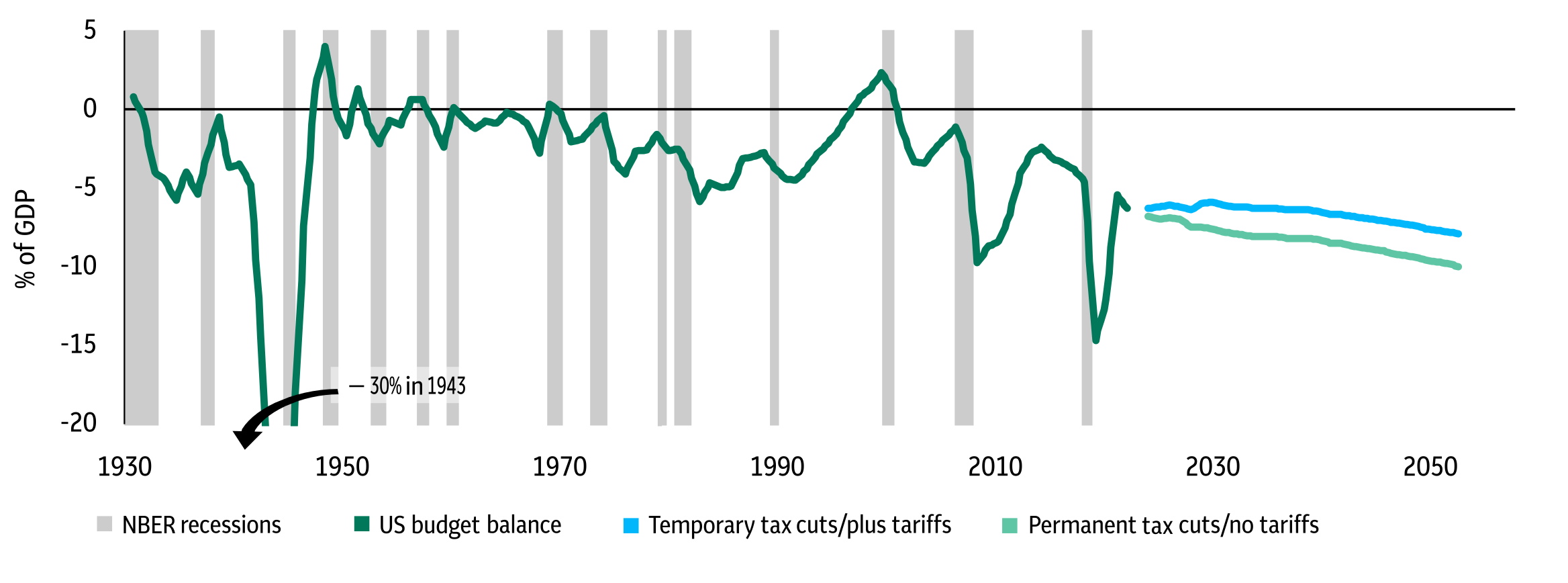
Figure 2:
As debt levels continue to accelerate away: US Federal government public debt
Sources: Minack Advisors, CBO, Federal Reserve, BEA, Yale Budget Lab, NBER
How to fund it: print or commandeer or just borrow more?
We’ve already witnessed efforts to tackle the widening shortfall, with initiatives such as the Department of Government Efficiency (DOGE), Liberation Day, and the resulting tariff volatility serving as prime examples. At the same time, political resistance and the urge among policymakers to appease increasingly unsettled populations - through measures like the OBBBA - highlight just how challenging it is to address these issues effectively.
We see three primary avenues likely to be increasingly relied upon to aid considerable fiscal funding needs:
- Increasing national capitalism initiatives to commandeer the required funds
- Central bank printing
- Continued increases in borrowing
The first avenue is a shift toward more ‘national capitalism’ initiatives. This could take many forms - from breaking norms, such as pressuring central bank independence, to encouraging greater holdings of national debt by private savings pools. If these measures prove insufficient, they could even extend to mandating funds for national projects or investments in sovereign debt. Other approaches include ongoing discussions around the establishment of a US sovereign wealth fund, getting creative with the GENUIS act, utilising US debt-backed stablecoins to stimulate demand for US debt, taking equity stakes in US companies, or revenue shares (akin to taxes) paid to the US government. Recent examples illustrate this trend: the US administration’s conversion of $9 billion in CHIPS Act grants into a 10% equity stake in Intel; unprecedented revenue share agreements with NVIDIA and AMD from AI chip sales to China; and several investments in mining and minerals, including rare earths and lithium. Canada and the UK are also actively pushing domestic investment through regulatory changes and incentives. In the UK, policymakers have signalled that mandatory rules could follow if voluntary commitments fail. Here, we note an obvious anomaly and ask: is the recent decade shift toward passive investing - resulting in ‘passive is massive’ and highly concentrated positions - aligned with an era of national priorities? Should investors in global indices be effectively sending money anyway without conscious and deliberate due diligence, especially when there are far greater priorities at home?
The second avenue is the likelihood that Central Banks resume quantitative easing (QE) aka money printing. Recall that policymakers, populations and financial markets had little qualms with the once completely ‘unthinkable’ liquidity induced responses by global central banks, particularly during COVID, to fund state of emergency fiscal programs to support their economies. What was previously ‘unthinkable’ is now seemingly acceptable, and policymakers, in pursuit of national interest needs, will eventually be tempted to utilise this policy manoeuvre again. Recent actions that appeared to undermine the independence of the US Federal Reserve further support this likelihood. As we highlighted in our prior note, ‘This is the path [of least resistance that] policymakers, both fiscal and monetary, are on. What policymakers need to occur, whether it be by sheer will, to manage volatility, or in crisis, they usually get - regardless of the unintended second–, third–, and fourth order consequences. Prepare for this, even if it takes the form of outright financial repression and leads toward national capitalism outcomes.’
The third and final avenue is to simply borrow more. That is, remain on the current path and gradually sleepwalk into an eventual fiscal crisis. While all attention may currently focus on the US, it is more likely that a smaller economy such as the UK or France will encounter difficulties first (witnessed during the UK with the so-called ‘Truss moment’). It is episodes like these that will keep financial market attention on this considerable and eventual risk.
How will they fund it: Our view
We expect all three approaches to be used in tandem to meet substantial fiscal funding needs. In the near term, there will likely be a stronger focus on expanding national capitalism-style policies, but overtime, central bank interventions - such as financial repression, yield curve controls, and quantitative easing - will become increasingly tempting and ultimately necessary. Policymakers may underestimate the seriousness of the growing fiscal challenge, continuing to rely on ever-increasing borrowing, meaning the current tail risk of a fiscal crisis eventually ensues. In other words, even on the most optimistic calculations, avoiding an eventual fiscal crisis appears unlikely, however, timing its arrival remains highly uncertain. We are closely monitoring countries like the UK, France and Japan as potential near-term flashpoints that could draw attention to unsustainable fiscal dynamic, potentially putting other nations, such as the US, under scrutiny as well. This growing tail risk is clearly reflected in the recent surge in gold prices, that will likely remain a key barometer as the situation develops. While many have concerns about the potential trajectory higher for bond yields, we remind readers that the hyper-financialization of the global economy over recent decades means any notable shift higher in bond yields would be incredibly disruptive to the US and global economy and as such measures to prevent this are expected to be as broad and as extreme as required. It may be natural to fear volatility in bond markets, although the hugely credit reliant economy that has been created over recent decades ultimately means this building pressure will be released elsewhere. Watch gold, and currency markets.
Figure 3:
Price of gold in USD

Source: Bloomberg, November 2025
What does this mean for bond markets? More resilient economic growth from fiscal stimulus, coupled with risks of running things too hot, could result in higher or stickier inflation. This dynamic likely means bond yields could remain at more elevated levels. Concerns over funding fiscal deficits, rising debt, and growing interest payments suggest that bond yields - especially at the long end - will remain volatile. At the same time, policymakers a) actively want lower yields to support national priorities b) are aware that higher bond yields make funding these national priorities more difficult, and c) are equipped with the tools to address these challenges. On balance, we expect bond yields to remain volatile within a range, trending lower overtime, with episodic risks where bond yields may spike higher briefly. The latter we see as opportunities to capitalise on.
What does this mean for credit markets? More resilient economic growth from the fiscal pulse, with risks of running things too hot will tend to be supportive for corporate health and credit markets. However, the moderately higher cost of capital currently being experienced is likely to persist, and this may be troublesome to the more leveraged components of credit market. We note the recent high-profile defaults of First Brands and Tricolor and associated malpractice involved. We anticipate a more persistent higher cost of capital environment will likely expose more ‘cockroaches,’ although very much acknowledge policymaker preference for financial market conditions that are conducive to pursuit of national priorities. As such, we expect a swift response to any genuine signs of stress. Again, bouts of volatility are viewed as opportunities to be taken advantage of.
Artificial Intelligence – Transformation technological boom, bubble or both?
At our Strategic Forum, it was undoubtedly clear that Artificial Intelligence (AI) or machine learning will and already is transforming the way we work. As such, we dedicated considerable time in the Forum to deeply research the topic, asking ourselves – is AI a transformational investment boom, a lofty investment bubble, or perhaps – both?

Every break-through technology, from steam to semiconductors, has sparked both exuberance and transformation (in that order)”
- the Perez model of technological revolution
In short, our analysis suggests that AI is very likely to enhance efficiency across many industries. However, it remains unclear who the primary beneficiaries will be or how they will convert these advancements into profits. Over the longer term, we expect to see many incremental winners across many industries (with ‘winner takes all’ scalers possible in each) rather than a few concentrated leaders that are currently benefitting from the significant build out phase today. AI works off Large Language Models (LLMs) – that requires considerable computing power (the GPUs and semiconductors ‘chips’) to run, hence companies like NVIDIA are benefitting from this enormous demand. LLMs require data centres to hold and power their servers, which results in a significant capital investment boom in data centre construction. As such, there is a huge investment boom underway and near term, this is good for economic growth. These drivers are propelling Mega Cap “AI 8” tech valuations higher and higher.
In trying to close the loop, there is a disconnect: it is very unclear at this stage how the return on this massive investment will translate into actual revenue and profit. Hence, there are significant questions as to whether the current valuations are justified. There are also some highly unusual, related and circular investments occurring. History suggests that when suppliers become your best customers, this is usually a poor sign.
Ok computer, engage infinite improbability drive…
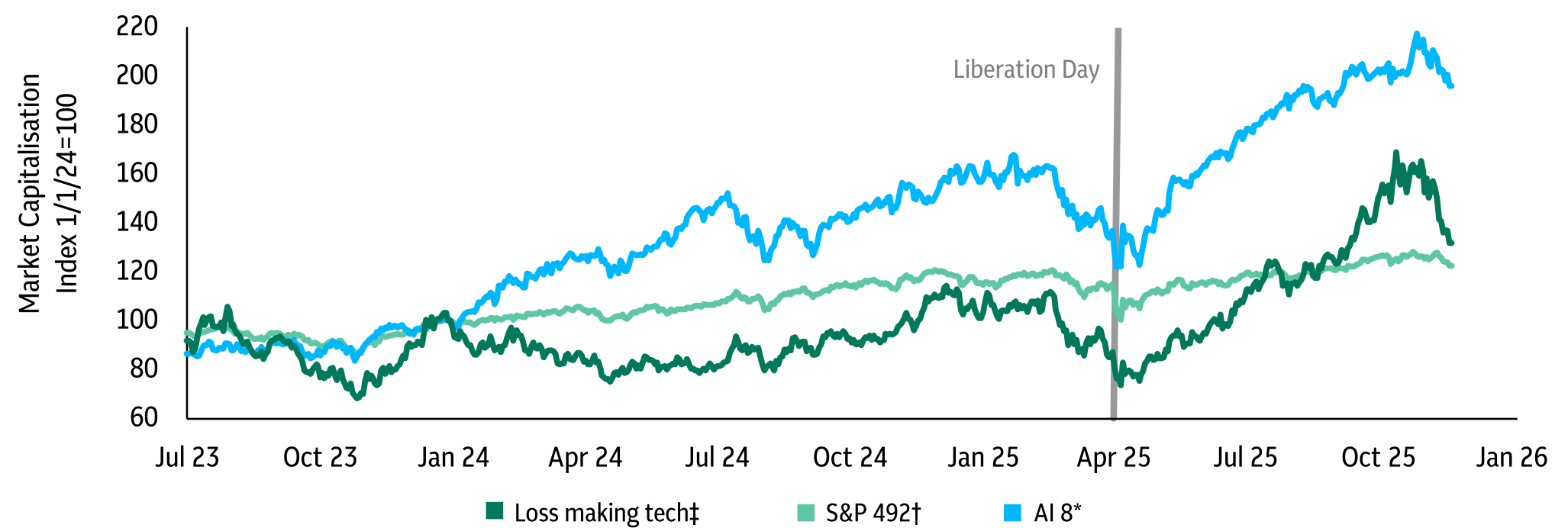
There are huge questions as to whether current valuations indicate an AI-driven financial market bubble, and potentially an enormous one. For context, we note it took NVIDIA over twenty years to reach a $1 trillion market‑capitalisation, an impressive feat on its own, but only four more years to become a $US 5 trillion company.1 For comparison, Japan’s nominal GDP is estimated to be $5 trillion, Germany’s at $4.5 trillion and the combined market capitalisation of the ‘AI8’ is $US 18.5 trillion.1 We simply ask: does this make sense?

Eventually, valuation has to matter”
- Howard Marks [Bubble.com 2000]
Figure 4:
Market capitalisation of the AI-8
Source: Macquarie, Minack, November 2025. *AI 8 = ALPHABET, MICROSOFT, NVIDIA, AMAZON, META, PALANTIR, BROADCOM & ORACLE. † SPX EX-AI 8. ‡ GSXUNPTC INDEX.
Passive is massive – ‘all in’ the same concentrated positions
We again highlight the increasing “passive is massive” phenomenon and its concentration in these trillion-dollar cap stocks - the AI8 - and remind readers of the far wider ramifications if this were to change direction. These Mega Cap tech companies led the rise in equity markets. As their prices rise, so does the NASDAQ, the S&P500, and the MSCI World Index, increasing their weights in all these indices. With so many investors, both retail and institutional, embracing low-cost diversified (although alas now concentrated) passive solutions, passive funds and ETFs buy all index constituents including more and more of the Mega Cap tech - a wonderful virtuous cycle. The more they go up, the more inflows they attract, and the more the market grinds higher. So much so as we conclude 2025, ~70% of the MSCI World Index is weighted toward US companies, with the AI 8 being a large part of that number. Most of the ‘passive is massive’ world is unaware of the lack of diversification (concentration) and reliance that imbued.
What happens if the hype and narrative, that is increasingly hard to believe, begins to unwind? What happens if this virtuous cycle ends? Linking this to our earlier theme of prioritising national investments, and the weighting to US assets in these passive funds, we ask: would any rational investor, other than unconscious passive ones, wait to find out? Many, it seems, are and will continue to wait. To stand out from the crowd, attempting to time the inevitable change in sentiment, is a step too far for too many.
Tying this to our prior dominant theme, if AI does indeed transform the workplace, it will likely alter employment markets considerably and potentially by extension, tax revenues. Unlike employees, machines don’t pay tax. Hence, collections for governments that are already running considerable deficits, with escalating entitlements, and unsustainable government debt levels, appear likely to face even greater challenges. Further, additional benefit payments may also be required if labour is displaced and could, under more populist policies extend to universal basic income payments. Eventually something will have to give.
What does this mean for bond markets? In our view, huge investment in AI infrastructure should be supportive for the economic growth outlook, and all things equal, means current bond yield levels may be maintained for a prolonged period. Although, in the event of a correction in the valuations of Mega Cap tech companies, along with their concentration in indices that have a massive passive investor base, we would expect bond yields to rally sharply (lower).
What does this mean for credit markets? Should the current euphoria and lofty valuations of Mega Cap tech continue, the outlook for credit markets remains benign. However, this would change quickly if the valuation bubble could no longer sustain itself. If this were to occur, the huge concentration of these companies in broader indices combined with their (in some cases extreme) valuation levels, the impact on broader financial markets would be significant. This would be further exacerbated by the passive is massive phenomenon, that has resulted in so many (either consciously or unconsciously) all being in the same trade. If this were to occur, we would expect credit markets to widen sharply. In such scenario (and it has a sense of inevitability about it), policymakers would likely be forced to respond quickly to contain the impact to broader financial markets and the broader economy.
Conclusion
Our core view centres around a clear preference for policy settings that prioritise and advance national interests. This entails favouring a lower cost of capital - supportive, and lower interest rates - actively responding to any shifts higher in bond yields by capping disruptive moves. We advocate for policies that foster robust economic growth and, consequently, healthy financial markets with abundant, affordable credit, supporting sustained or rising asset prices. In this environment, buying into market dips during periods of volatility in rates and credit should prove rewarding, as policymakers seek to contain economic conditions that are favourable to economic progress. To succumb to a recession at this juncture in the geo-political landscape is to risk falling behind, and that risk is intolerable.
While this core view will likely see investors fare well, a close eye on the growing tail risk scenarios outlined in this note (and being on alert to react) is also very prudent. These tail risks include: a rising likelihood of fiscal crises as government debt levels continue to climb; the risk of an AI-driven stock market bubble burst, escalating geopolitical tensions and conflict as national interests clash with those who benefited from globalization; and lastly the risk of stickier inflation as a result of running the economy too hot. Any one of these tail risks, or a combination of them, could become more prominent and shift toward the centre of attention in the coming months. The year ahead looks set to be eventful.
Author
[11/25 - 4537330]
IMPORTANT INFORMATION
The opinions expressed are those of the author(s) are as of the date indicated and may change based on market and other conditions. The accuracy of the content and its relevance to your client’s particular circumstances is not guaranteed.
This market commentary has been prepared for general informational purposes by the team, who are part of Macquarie Asset Management (MAM), the asset management business of Macquarie Group (Macquarie), and is not a product of the Macquarie Research Department. This market commentary reflects the views of the team and statements in it may differ from the views of others in MAM or of other Macquarie divisions or groups, including Macquarie Research. This market commentary has not been prepared to comply with requirements designed to promote the independence of investment research and is accordingly not subject to any prohibition on dealing ahead of the dissemination of investment research.
Nothing in this market commentary shall be construed as a solicitation to buy or sell any security or other product, or to engage in or refrain from engaging in any transaction. Macquarie conducts a global full-service, integrated investment banking, asset management, and brokerage business. Macquarie may do, and seek to do, business with any of the companies covered in this market commentary. Macquarie has investment banking and other business relationships with a significant number of companies, which may include companies that are discussed in this commentary, and may have positions in financial instruments or other financial interests in the subject matter of this market commentary. As a result, investors should be aware that Macquarie may have a conflict of interest that could affect the objectivity of this market commentary. In preparing this market commentary, we did not take into account the investment objectives, financial situation or needs of any particular client. You should not make an investment decision on the basis of this market commentary. Before making an investment decision you need to consider, with or without the assistance of an adviser, whether the investment is appropriate in light of your particular investment needs, objectives and financial circumstances.
Macquarie salespeople, traders and other professionals may provide oral or written market commentary, analysis, trading strategies or research products to Macquarie’s clients that reflect opinions which are different from or contrary to the opinions expressed in this market commentary. Macquarie’s asset management business (including MAM), principal trading desks and investing businesses may make investment decisions that are inconsistent with the views expressed in this commentary. There are risks involved in investing. The price of securities and other financial products can and does fluctuate, and an individual security or financial product may even become valueless. International investors are reminded of the additional risks inherent in international investments, such as currency fluctuations and international or local financial, market, economic, tax or regulatory conditions, which may adversely affect the value of the investment. This market commentary is based on information obtained from sources believed to be reliable, but we do not make any representation or warranty that it is accurate, complete or up to date. We accept no obligation to correct or update the information or opinions in this market commentary. Opinions, information, and data in this market commentary are as of the date indicated on the cover and subject to change without notice. No member of the Macquarie Group accepts any liability whatsoever for any direct, indirect, consequential or other loss arising from any use of this market commentary and/or further communication in relation to this market commentary. Some of the data in this market commentary may be sourced from information and materials published by government or industry bodies or agencies, however this market commentary is neither endorsed or certified by any such bodies or agencies. This market commentary does not constitute legal, tax accounting or investment advice. Recipients should independently evaluate any specific investment in consultation with their legal, tax, accounting, and investment advisors. Past performance is not indicative of future results.
This market commentary may include forward looking statements, forecasts, estimates, projections, opinions and investment theses, which may be identified by the use of terminology such as “anticipate”, “believe”, “estimate”, “expect”, “intend”, “may”, “can”, “plan”, “will”, “would”, “should”, “seek”, “project”, “continue”, “target” and similar expressions. No representation is made or will be made that any forward-looking statements will be achieved or will prove to be correct or that any assumptions on which such statements may be based are reasonable. A number of factors could cause actual future results and operations to vary materially and adversely from the forward-looking statements. Qualitative statements regarding political, regulatory, market and economic environments and opportunities are based on the team’s opinion, belief and judgment.
Other than Macquarie Bank Limited ABN 46 008 583 542 (“Macquarie Bank”), any Macquarie Group entity noted in this website is not an authorized deposit-taking institution for the purposes of the Banking Act 1959 (Commonwealth of Australia). The obligations of these other Macquarie Group entities do not represent deposits or other liabilities of Macquarie Bank. Macquarie Bank does not guarantee or otherwise provide assurance in respect of the obligations of these other Macquarie Group entities. In addition, if this website relates to an investment, (a) the investor is subject to investment risk including possible delays in repayment and loss of income and principal invested and (b) none of Macquarie Bank or any other Macquarie Group entity guarantees any particular rate of return on or the performance of the investment, nor do they guarantee repayment of capital in respect of the investment.
Past performance does not guarantee future results.
Diversification may not protect against market risk.
Fixed income securities are subject to credit risk, which is the risk of loss of principal or loss of a financial reward stemming from a borrower’s failure to repay a loan or otherwise meet a contractual obligation. Credit risk arises whenever a borrower expects to use future cash flows to pay a current debt. Investors are compensated for assuming credit risk by way of interest payments from the borrower or issuer of a debt obligation. Credit risk is closely tied to the potential return of an investment, the most notable being that the yields on bonds correlate strongly to their perceived credit risk.
Fixed income securities are also subject to interest rate risk, which is the risk that the prices of fixed income securities will increase as interest rates fall and decrease as interest rates rise. Interest rate changes are influenced by a number of factors, such as government policy, monetary policy, inflation expectations, and the supply and demand of securities. Fixed income securities with longer maturities or duration generally are more sensitive to interest rate changes.
Quantitative easing (QE) is a government monetary policy used to increase the money supply by buying government securities or other securities from the market. Quantitative easing increased the money supply by flooding financial institutions with capital in an effort to promote increased lending and liquidity.
A Treasury yield refers to the effective yearly interest rate the US government pays on money it borrows to raise capital through selling Treasury bonds, also referred to as Treasury notes or Treasury bills depending on maturity length.
The yield curve is a line that plots the interest rates, at a set point in time, of bonds having equal credit quality, but differing maturity dates. The most frequently reported yield curve compares the 3-month, 2-year, 5-year, and 30-year US Treasury debt. This yield curve is used as a benchmark for other debt in the market, such as mortgage rates or bank lending rates. It is also used to predict changes in economic output and growth.
The shape of the yield curve is closely scrutinized because it helps to give an idea of future interest rate change and economic activity. There are three main types of yield curve shapes: normal, inverted and flat (or humped). A normal yield curve is one in which longer maturity bonds have a higher yield compared to shorter-term bonds due to the risks associated with time. An inverted yield curve is one in which the shorter-term yields are higher than the longer-term yields, which can be a sign of upcoming recession. A flat (or humped) yield curve is one in which the shorterand longer-term yields are very close to each other, which is also a predictor of an economic transition. The slope of the yield curve is also seen as important: the greater the slope, the greater the gap between short- and long-term rates.
Yield curve inversion is when coupon payments on shorter-term Treasury bonds exceed the interest paid on longer-term bonds.
The S&P 500® Index measures the performance of 500 mostly large-cap stocks weighted by market value and is often used to represent performance of the US stock market.
The MSCI World Index represents large- and midcap stocks across 23 developed market countries worldwide. The index covers approximately 85% of the free float-adjusted market capitalization in each country.
Index performance returns do not reflect any management fees, transaction costs or expenses. Indices are unmanaged and one cannot invest directly in an index.
Economic trend information is sourced from Bloomberg unless otherwise noted.
Macquarie Group, its employees and officers may act in different, potentially conflicting, roles in providing the financial services referred to in this document. The Macquarie Group entities may from time to time act as trustee, administrator, registrar, custodian, investment manager or investment advisor, representative or otherwise for a product or may be otherwise involved in or with, other products and clients which have similar investment objectives to those of the products described herein. Due to the conflicting nature of these roles, the interests of Macquarie Group may from time to time be inconsistent with the Interests of investors. Macquarie Group entities may receive remuneration as a result of acting in these roles. Macquarie Group has conflict of interest policies which aim to manage conflicts of interest.
All third-party marks cited are the property of their respective owners
© 2025 Macquarie Group Limited
For Australian audiences this information is provided by Macquarie Investment Management Global Limited (ABN 90 086 159 060 AFSL 237843). The information is provided for general information purposes only and is not, and should not be construed as, an advertisement, an invitation, an offer, a solicitation of an offer or a recommendation to participate in any investment strategy or take any other action, including to buy or sell any product or security or offer any banking or financial service or facility by any member of the Macquarie Group. This information has been prepared without taking into account any person’s objectives, financial situation or needs. Recipients should not construe the contents of this document as financial, investment or other advice. It should not be relied on in making any investment decision.
Nothing in this document constitutes a recommendation to buy, sell or hold any financial product, security or instrument.
Future results are impossible to predict. This document contains opinions, conclusions, estimates and other forward-looking statements which are, by their very nature, subject to various risks and uncertainties. Actual events or results may differ materially, positively or negatively, from those reflected or contemplated in such forward-looking statements.
Past performance information shown herein, is not a reliable indicator of future performance. No representation or warranty, express or implied, is made as to the suitability, accuracy, currency or completeness of the information, opinions and conclusions contained in this document. In preparing this document, reliance has been placed, without independent verification, on the accuracy and completeness of information available from external sources. To the maximum extent permitted by law, no member of the Macquarie Group nor its directors, employees or agents accept any liability for any loss arising from the use of this document, its contents or otherwise arising in connection with it.