Building weather resilience into solar infrastructure
Enhancing resilience of utility‑scale solar assets in hail‑exposed regions through advanced tracker technology and proactive insurance risk management
Swipe for more
| Sector | Energy |
| Sub-sector | Renewables (solar) |
| Location | North America |
Opportunity
Headquartered in Austin, Texas, Treaty Oak Clean Energy (Treaty Oak) develops and operates utility‑scale solar and battery storage assets in the United States, navigating a solar development landscape increasingly shaped by severe weather risk.
As solar deployment accelerates, managing physical climate risks has become a core driver of long‑term value – supporting asset resilience, insurability and capital protection. Hail is a leading cause of insured losses across US solar portfolios - with large format solar panels facing heightened exposure to damage, replacement costs, revenue disruption and tighter insurance terms due to their thinner, semi-tempered dual glass construction.1,2
Against this backdrop, Treaty Oak sought a solution that could improve the resilience of its assets over a multi-decade operating life, without compromising energy yield, security, or constructability.
Approach
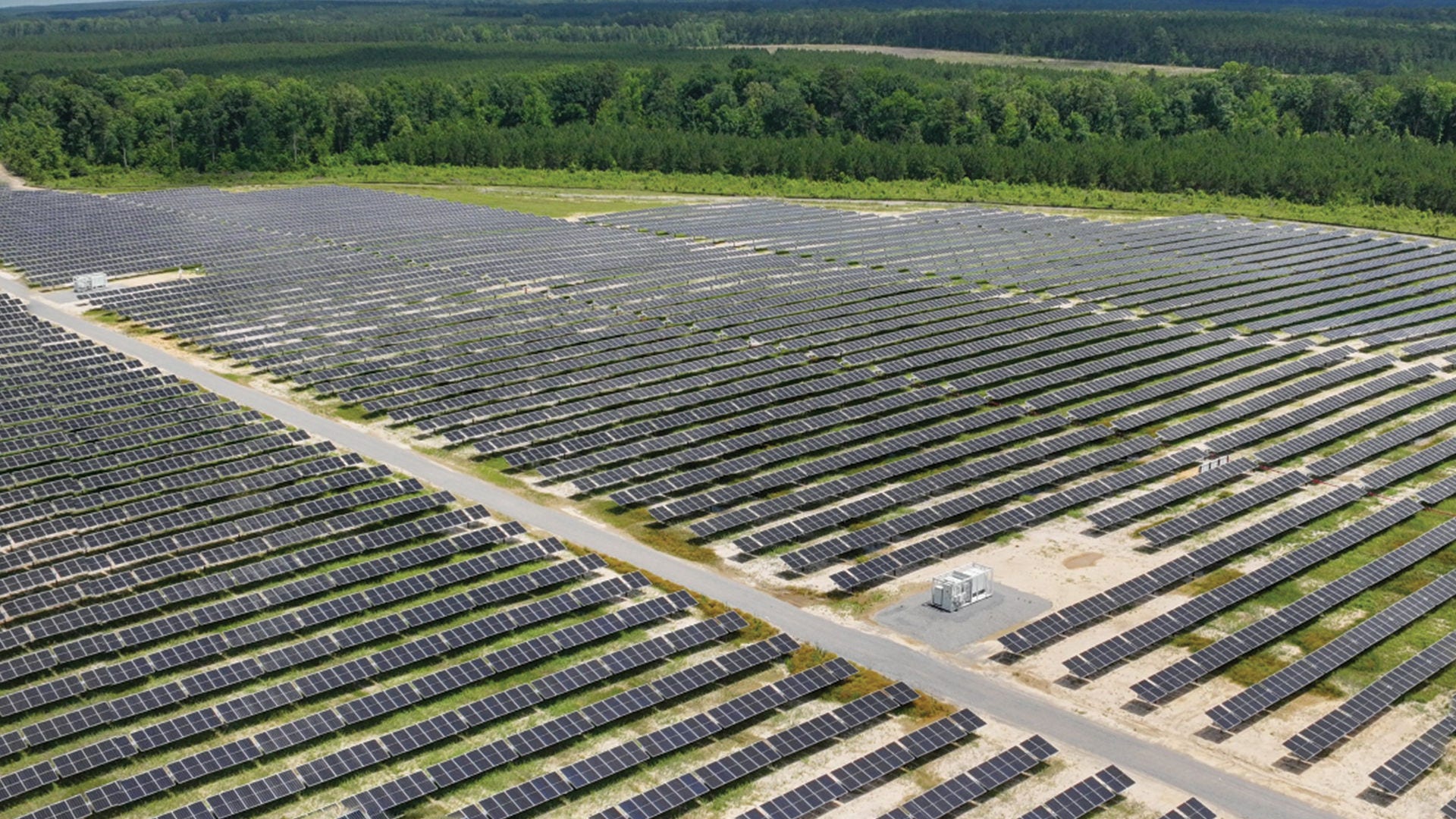
In December 2024, backed by the financial support from a Macquarie Asset Management (MAM)-managed fund, Treaty Oak reached financial close and began construction on a ~100 MW solar project in Arkansas, after securing a 15-year power purchase agreement (PPA) with a leading global technology company.
To protect against potential hail damage, Treaty Oak partnered with Nextpower to implement an advanced weather warning and automatic high‑angle stowing solution, tilting solar panels to steeper angles in advance of hailstorms.3
By increasing the stow angle of solar panels to a steeper 75° angle, versus the typical 60° position, the kinetic energy from hailstone impacts is significantly reduced, directly lowering the risk of panel breakage, revenue disruption and costly replacements.4,5 To quantify the resilience benefit, Treaty Oak commissioned independent natural-catastrophe modelling across four of its sites. The results of this analysis showed a higher stow angle reduced the Probable Maximum Loss (PML), the estimated worst-case financial loss from a single severe storm event, by 32-45 per cent.6
Outcome
In April 2026, Treaty Oak successfully completed construction of the Redfield solar project, demonstrating that enhanced resilience and commercial performance are complementary - with measurable reductions in construction costs and improved insurance terms achieved.
Compared with the alternative of upgrading to thicker, more impact-resistant glass panels, the high-angle auto-stow solution reduced upfront capital costs by approximately 1 per cent, making it the most capital-efficient and hail-resilient solution available.7 The improved risk profile also supported access to more comprehensive insurance coverage, including a broader panel of insurers willing to quote and more favourable terms on rate, deductible and sub-limit, helping keep the project’s PML within the available market capacity for severe convective storm coverage, a constraint that has tightened materially for solar developers in hail-exposed states.
Treaty Oak has since adopted the same design across its Southeast US pipeline, with independent modelling confirming the resilience benefit translates across geographies and site sizes. This approach has helped Treaty Oak support operating performance by mitigating downtime, protecting replacement value, and maintaining long‑term insurability against physical climate risks.

32-45 per cent
reduction in Probable Maximum Loss across the four modelled sites8

~1 per cent
capex reduction by implementing the auto-stow technology compared with alternative solutions9

~100 MW
Redfield Solar project in Arkansas successfully completed construction in April 2026

First
large-scale utility solar project to deploy both a 75° maximum tilt and automated hail stow functionality
1. kWh Analytics, Solar Risk Assessment 2025
2. Nextpower, NX Horizon with Hail Pro Deploys Gigawatt-Scale Portfolio, 2026
3. Nextpower, https://nextpower.com/
4. Nextpower, https://nextpower.com/
5. kWh Analytics, Solar Risk Assessment 2024
6. Based on independent analysis conducted by a third-party consultant. Loss estimates modelled using four scenarios varying panel glass thickness (2.0mm / 3.2mm) and stow angle (60° / 75°), expressed as a Probable Maximum Loss (PML) for a 500-year return period storm event.
7. Based on analysis completed by Treaty Oak as at May 2026.
8. Based on independent analysis conducted by a third-party consultant as at May 2026. Loss estimates modelled using four scenarios varying panel glass thickness (2.0mm / 3.2mm) and stow angle (60° / 75°), expressed as a Probable Maximum Loss (PML) for a 500-year return period storm event.
9. Based on analysis completed by Treaty Oak as at May 2026.
Learn more