
- Preqin
- Pitchbook LCD
- KBRA DLD Default Research. Includes payment defaults, bankruptcies, distressed debt exchanges and restructurings, and distressed exits.
- Historical default and loss rates - Cliffwater Report on US Direct Lending (4Q2023), JP Morgan Markets (2024), Moody’s Infrastructure default and recovery rates (2023).
- Global Infrastructure Outlook. Infrastructure Debt investment opportunity estimated to be 60% of the capital stack required to plug the $18trn funding gap between total investment needed ($97trn) and public sector funding forecasts ($79trn).


Outlook 2026
Private credit
Activity picking up and structural growth drivers provide long-term support
In light of recent events, disciplined underwriting and portfolio resilience within private credit are proving increasingly critical. Against a backdrop of heightened volatility after a long period of a benign credit environment, we think there is the potential for some borrowers to face challenges. That said, we expect secular shifts in market dynamics and structural features of private credit to continue driving long-term demand for the flexible solutions the asset class provides to borrowers and the diversification opportunities it offers investors.
We expect fundraising sources to continue to diversify as insurance and wealth investors channel capital into private credit in increasing volumes. By 2028, private credit AUM is projected to reach $US2.8 trillion,1 with direct lending still dominant, though allocations to asset-backed finance (ABF) strategies are expected to rise as investors seek differentiated exposure. In our view, well-structured deals that incorporate appropriate protections, and lending to borrowers with robust underlying earnings, are key differentiators in an increasingly crowded private credit marketplace.
Direct lending: M&A uptick to drive deal volumes higher
The outlook for direct lending in 2026 is strong in the US and Europe. In both markets, we expect an uptick in deal volumes driven by increasing private equity M&A activity as interest rates continue to moderate in the US and UK, while remaining low in Europe. In the US, year-to-date 2025 volumes are down from the same period last year, due largely to market volatility and the uncertainty introduced by US tariff policy, while in Europe direct lending deal activity appears on track to beat 2024 issuance.2
Spreads in both the US and Europe continued to tighten throughout 2025. Looking ahead, we see a flattening of these spread levels, with the potential for some expansion if market conditions worsen. Despite the spread compression, we continued to see good premiums in private markets compared with the broadly syndicated loan (BSL) market (Figure 1).
Fig 1: Direct lending continues to offer an attractive spread over the BSL market
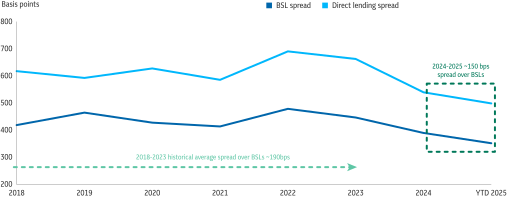 Source: Pitchbook LCD, data through 30 September 2025.
Default rates in direct lending have remained low, with trailing 12-month (TTM) default rates, as at October 2025, standing at 1.5% in the US and 1.3% in Europe.3 Looking forward to 2026, we see the potential for some modest increase in default rates as borrowers are faced with continued volatility and uncertainty, but we expect them to remain moderate overall.
Asset-backed finance: Compelling fundamentals
Investor appetite is diversifying within private credit. This is true for both institutional and wealth investors, who are now increasingly turning their attention to the broad universe of ABF.
We view ABF broadly as encompassing finance underpinned either by (1) real assets, including infrastructure, equipment, real estate, and transportation, or (2) specialty assets, including net asset value (NAV) lending, consumer finance, contractual cash flows, and other commercial lending. Estimates suggest this market is $US5.5 trillion in the US.
Within ABF, infrastructure debt stands out as a particularly resilient asset class that we think is set for growth given the trends described below. Investments are typically backed by essential, long-lived assets with stable cash flows and high barriers to entry. These defensive characteristics enable infrastructure debt to deliver stable returns across economic cycles and consistently lower default and loss rates compared with general corporate credit4 (Figure 2).
Figure 2: Historical asset class default rates and expected loss
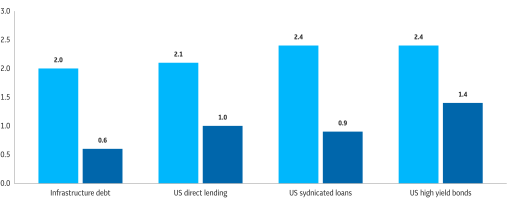 Sources: Cliffwater Report on US Direct Lending (4Q2023), JP Morgan Markets (2024), Moody’s Infrastructure default and recovery rates (2023).
Secular growth drivers are fuelling global demand for infrastructure investment. The secular trends of decarbonisation, digitalisation, deglobalisation, and demographics (the four Ds) are creating vast opportunities in sectors such as data infrastructure, renewable energy, and essential services. Five years ago, estimates from the Global Infrastructure Hub suggested that the total investment need for infrastructure and related sectors could reach $US97 trillion by 2040. Based on forecasts of infrastructure investment, assuming that countries continue to invest in line with current trends and in response to changes in economic and demographic fundamentals, it is estimated the total funding gap left for private markets is more than $US18 trillion, of which we expect private infrastructure debt to account for ~$US11 trillion.5
To meet the need for investment, we are seeing improved accessibility into these types of strategies for investors. Greater demand from investors is improving liquidity, new investment vehicles are lowering barriers to entry for individual investors and retirement portfolios, and increasing transparency is contributing to the expansion of the investor base. We believe maintaining focus and unlocking expertise in carefully identified market segments will be a key differentiator in successfully delivering risk-adjusted returns. We expect this trend to continue and to drive further growth and opportunities for investors in the private credit market.

James Lumb
Global Private Credit Strategist
This information is intended for the audiences as indicated. It is not to be distributed to, or disclosed to retail investors.
The views expressed in this document represent those of the relevant investment team and are subject to change. No information set out in this document constitutes advice, an advertisement, an invitation, a confirmation, an offer or a solicitation, to buy or sell any security or other financial product or to engage in any investment activity, or an offer of any banking or financial service. Some products and/or services mentioned in this document may not be suitable for you and may not be available in all jurisdictions.
This market commentary has been prepared for general informational purposes by the team, who are part of Macquarie Asset Management (MAM), the asset management business of Macquarie Group (Macquarie), and is not a product of the Macquarie Research Department. This market commentary reflects the views of the team and statements in it may differ from the views of others in MAM or of other Macquarie divisions or groups, including Macquarie Research. This market commentary has not been prepared to comply with requirements designed to promote the independence of investment research and is accordingly not subject to any prohibition on dealing ahead of the dissemination of investment research.
Nothing in this market commentary shall be construed as a solicitation to buy or sell any security or other product, or to engage in or refrain from engaging in any transaction. Macquarie conducts a global full-service, integrated investment banking, asset management, and brokerage business. Macquarie may do, and seek to do, business with any of the companies covered in this market commentary.
Macquarie has investment banking and other business relationships with a significant number of companies, which may include companies that are discussed in this commentary, and may have positions in financial instruments or other financial interests in the subject matter of this market commentary. As a result, investors should be aware that Macquarie may have a conflict of interest that could affect the objectivity of this market commentary. In preparing this market commentary, we did not take into account the investment objectives, financial situation or needs of any particular client. You should not make an investment decision on the basis of this market commentary. Before making an investment decision you need to consider, with or without the assistance of an adviser, whether the investment is appropriate in light of your particular investment needs, objectives and financial circumstances.
Macquarie salespeople, traders and other professionals may provide oral or written market commentary, analysis, trading strategies or research products to Macquarie’s clients that reflect opinions which are different from or contrary to the opinions expressed in this market commentary. Macquarie’s asset management business (including MAM), principal trading desks and investing businesses may make investment decisions that are inconsistent with the views expressed in this commentary. There are risks involved in investing. The price of securities and other financial products can and does fluctuate, and an individual security or financial product may even become valueless. International investors are reminded of the additional risks inherent in international investments, such as currency fluctuations and international or local financial, market, economic, tax or regulatory conditions, which may adversely affect the value of the investment. This market commentary is based on information obtained from sources believed to be reliable, but we do not make any representation or warranty that it is accurate, complete or up to date. We accept no obligation to correct or update the information or opinions in this market commentary. Opinions, information, and data in this market commentary are as of the date indicated on the cover and subject to change without notice. No member of the Macquarie Group accepts any liability whatsoever for any direct, indirect, consequential or other loss arising from any use of this market commentary and/or further communication in relation to this market commentary. Some of the data in this market commentary may be sourced from information and materials published by government or industry bodies or agencies, however this market commentary is neither endorsed or certified by any such bodies or agencies. This market commentary does not constitute legal, tax accounting or investment advice. Recipients should independently evaluate any specific investment in consultation with their legal, tax, accounting, and investment advisors. Past performance is not indicative of future results.
This market commentary may include forward looking statements, forecasts, estimates, projections, opinions and investment theses, which may be identified by the use of terminology such as “anticipate”, “believe”, “estimate”, “expect”, “intend”, “may”, “can”, “plan”, “will”, “would”, “should”, “seek”, “project”, “continue”, “target” and similar expressions. No representation is made or will be made that any forward-looking statements will be achieved or will prove to be correct or that any assumptions on which such statements may be based are reasonable. A number of factors could cause actual future results and operations to vary materially and adversely from the forward-looking statements. Qualitative statements regarding political, regulatory, market and economic environments and opportunities are based on the team’s opinion, belief and judgment.
Past performance does not guarantee future results.
Diversification may not protect against market risk.
Credit risk is the risk of loss of principal or loss of a financial reward stemming from a borrower’s failure to repay a loan or otherwise meet a contractual obligation. Credit risk arises whenever a borrower expects to use future cash flows to pay a current debt. Investors are compensated for assuming credit risk by way of interest payments from the borrower or issuer of a debt obligation. Credit risk is closely tied to the potential return of an investment, the most notable being that the yields on bonds correlate strongly to their perceived credit risk.
Currency risk is the risk that fluctuations in exchange rates between the US dollar and foreign currencies and between various foreign currencies may cause the value of an investment to decline. The market for some (or all) currencies may from time to time have low trading volume and become illiquid, which may prevent an investment from effecting positions or from promptly liquidating unfavourable positions in such markets, thus subjecting the investment to substantial losses.
Fixed income securities are subject to credit risk, which is the risk of loss of principal or loss of a financial reward stemming from a borrower’s failure to repay a loan or otherwise meet a contractual obligation.
Fixed income securities are also subject to interest rate risk, which is the risk that the prices of fixed income securities will increase as interest rates fall and decrease as interest rates rise.
Interest rate changes are influenced by a number of factors, such as government policy, monetary policy, inflation expectations, and the supply and demand of securities. Fixed income securities with longer maturities or duration generally are more sensitive to interest rate changes.
Fixed income securities may also be subject to prepayment risk, which is the risk that the principal of a bond that is held by a portfolio will be prepaid prior to maturity at the time when interest rates are lower than what the bond was paying. A portfolio may then have to reinvest that money at a lower interest rate. Infrastructure companies are subject risks including increased costs associated with capital construction programs and environmental regulations, surplus capacity, increased competition, availability of fuel at reasonable prices, energy conservation policies, difficulty in raising capital, and increased susceptibility to terrorist acts or political actions.
Investment strategies that hold securities issued by companies principally engaged in the infrastructure industry have greater exposure to the potential adverse economic, regulatory, political, and other changes affecting such entities.
International investments entail risks including fluctuation in currency values, differences in accounting principles, or economic or political instability. Investing in emerging markets can be riskier than investing in established foreign markets due to increased volatility, lower trading volume, and higher risk of market closures. In many emerging markets, there is substantially less publicly available information and the available information may be incomplete or misleading. Legal claims are generally more difficult to pursue.
Market risk is the risk that all or a majority of the securities in a certain market – like the stock market or bond market – will decline in value because of factors such as adverse political or economic conditions, future expectations, investor confidence, or heavy institutional selling.
Liquidity risk is the possibility that securities cannot be readily sold within seven days at approximately the price at which a fund has valued them.
A capitalisation rate (cap rate) is a percentage that estimates the potential return on investment for a property. It’s a common metric used in real estate to compare the value of different properties.
Internal rate of return (IRR) is a metric used in financial analysis to estimate the profitability of potential investments. IRR is a discount rate that makes the net present value (NPV) of all cash flows equal to zero in a discounted cash flow analysis.
Economic trend information is sourced from Bloomberg unless otherwise noted.
Macquarie Group, its employees and officers may act in different, potentially conflicting, roles in providing the financial services referred to in this document. The Macquarie Group entities may from time to time act as trustee, administrator, registrar, custodian, investment manager or investment advisor, representative or otherwise for a product or may be otherwise involved in or with, other products and clients which have similar investment objectives to those of the products described herein. Due to the conflicting nature of these roles, the interests of Macquarie Group may from time to time be inconsistent with the Interests of investors. Macquarie Group entities may receive remuneration as a result of acting in these roles. Macquarie Group has conflict of interest policies which aim to manage conflicts of interest.
All third-party marks cited are the property of their respective owners.
Macquarie Asset Management (MAM) is the asset management division of Macquarie Group. MAM is an integrated asset manager across public and private markets offering a diverse range of capabilities, including real assets, real estate, credit, equities and multi-asset solutions.
This information is a general description of Macquarie Asset Management only. The views expressed in this website represent those of the relevant investment team and are subject to change. No information set out above constitutes advice, an advertisement, an invitation, a confirmation, an offer or a solicitation, to buy or sell any security or other financial product or to engage in any investment activity, or an offer of any banking or financial service. Some products and/or services mentioned on this website may not be suitable for you and may not be available in all jurisdictions.
Investing involves risk including the possible loss of principal. The investment capabilities described in this website involve risks due, among other things, to the nature of the underlying investments. All examples herein are for illustrative purposes only and there can be no assurance that any particular investment objective will be realized or any investment strategy seeking to achieve such objective will be successful.
Past performance is not a reliable indication of future performance.
Before acting on any information, you should consider the appropriateness of it having regard to your particular objectives, financial situation and needs and seek advice.
Other than Macquarie Bank Limited ABN 46 008 583 542 (“Macquarie Bank”), any Macquarie Group entity noted in this website is not an authorized deposit-taking institution for the purposes of the Banking Act 1959 (Commonwealth of Australia). The obligations of these other Macquarie Group entities do not represent deposits or other liabilities of Macquarie Bank. Macquarie Bank does not guarantee or otherwise provide assurance in respect of the obligations of these other Macquarie Group entities. In addition, if this website relates to an investment, (a) the investor is subject to investment risk including possible delays in repayment and loss of income and principal invested and (b) none of Macquarie Bank or any other Macquarie Group entity guarantees any particular rate of return on or the performance of the investment, nor do they guarantee repayment of capital in respect of the investment.