

Outlook 2026

Real estate

Valuations and improving fundamentals to drive returns

Commercial property fundamentals are healthy, valuations have stabilised, and credit is becoming easier, which points to an ongoing recovery of global real estate. The environment is positive for investors with medium- to long-term horizons, where income growth is set to boost returns. Real estate equity is now looking attractive again on a risk-adjusted basis against other asset classes following a reset in valuations with interest rates normalising. Development activity remains constrained due to high construction costs, which is set to create supply shortages over the next decade, though there are signs that cost inflation is normalising.

Behind these averages lie different trends across markets and sectors, and demand drivers continue to evolve in line with global structural shifts driven by digitalisation, demographics, and deglobalisation. The strongest opportunities lie in asset types supported by underlying demand-supply imbalances over the next decade, such as living, logistics, and data centres. Developers building into this supply-constrained environment are well positioned for strong returns. 

Attractive valuations following a pricing reset

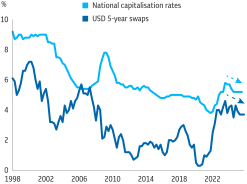
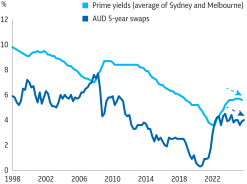
Real estate valuations ex-Japan have reset from 2023 peaks, presenting cyclical opportunities for investors to build their property exposure with downside protection. Real estate yields have expanded sharply across most sectors and markets, creating better entry points for new capital (Figures 1 and 2). Further monetary easing, which feeds into lower ‘all-in’ debt costs, alongside improving credit conditions, is set to boost the attractiveness of real estate.

Figure 1: Real estate valuations are gradually lifting in sectors with solid demand-supply fundamentals – US multifamily

Figure 2: Real estate valuations are gradually lifting in sectors with solid demand-supply fundamentals – Australian logistics

Sources: Bloomberg, Macrobond, Green Street, JLL (November 2025).


Subdued development activity to fuel rent increases

Higher construction costs and capitalisation rates and increased financing expenses are suppressing construction levels and reducing new project activity across property sectors, excluding data centres and selective subsectors such as build-to-rent and land lease communities. Subdued activity is creating supply shortages as demand stabilises, which is set to support higher rents and occupancy rates over the coming decade. Development margins will improve again as the cycle progresses and property prices and rents outstrip costs. 

Living’s strong demand-supply imbalances 

Residential real estate continues to demonstrate robust investment fundamentals, driven by persistent demand-supply imbalances across many developed markets. The sector’s strong linkages to inflation and its ability to generate resilient cash flows throughout economic cycles underpin its appeal to long-term investors. Affordability challenges in home ownership – exacerbated by high prices and mortgage rates – are directly fuelling demand for rental housing. This trend is most common among young people, key workers, and lower- to middle-income households who are often unable to afford homeownership. Solid population growth, particularly in gateway cities across Europe and Asia-Pacific, is projected to sustain upward pressure on rents and asset prices over the next decade. These cities often face subdued new supply levels due to restrictive planning regimes, high construction costs, and limited land availability. 

Population growth and ageing demographics

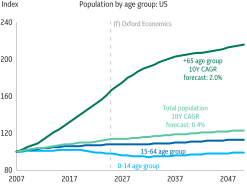
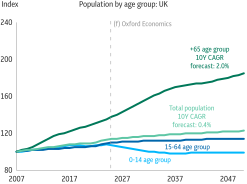
Demographics play a pivotal role in shaping demand for more affordable housing options across different markets and age groups (Figures 3 and 4). For key workers and retirees, segments such as manufactured homes, seniors housing, and land lease communities offer viable, cost-effective alternatives. Strong population growth and market barriers, including complex planning or high entry costs, drive demand in these sectors. These factors restrict the pace of new supply, helping to underpin rental growth and income stability for investors.

Additionally, the evolving preferences of younger generations – who increasingly prioritise flexibility and urban living – are contributing to the growth of build-to-rent and co-living models. These alternatives offer attractive amenities and community-focused environments, catering to shifting lifestyle needs. The living sector’s combination of structural demand drivers, supply constraints, and demographic tailwinds positions it as a resilient and attractive investment opportunity in the face of broader economic uncertainty. 

Figure 3: Demographics support demand for affordable housing such as land lease communities – US

Figure 4: Demographics support demand for affordable housing such as land lease communities – UK

Source: Oxford Economics (November 2025).
 

Shifting logistics and warehousing dynamics and drivers

The industrial property sector is undergoing a sizeable transformation, driven by evolving logistics and warehousing dynamics. Persistent shortages of high-quality, modern facilities – coupled with ongoing demands for supply chain efficiency and shifting global trade patterns – are set to fuel robust logistics demand over the next decade. This outlook persists despite some near-term headwinds, including softer demand and elevated supply in selective submarkets.

Over the past year, the sector has witnessed a more balanced leasing environment. This shift is attributable to maturing ecommerce penetration, heightened trade uncertainty, and affordability challenges stemming from rising rents and broader cost pressures for occupiers. While these factors have tempered immediate growth, they have also contributed to a healthier, more sustainable market equilibrium.

Despite recent challenges, investor interest in logistics properties remains strong. The sector accounts for 25% of total sales across traditional property segments, up from a historical average of 15%. Buoyant debt markets continue to support investment activity, a trend likely to persist as pressure mounts on other core sectors. Higher cap rates, lower capex compared with traditional sectors, and steady rental growth reinforce the sector’s attractive investment thesis.

Looking ahead, both demand and rental growth are poised to accelerate as supply chains continue to adapt to geopolitical shifts and the reordering of global trade. Rising real incomes will support increased consumer spending, including online sales, while occupiers compete for a limited supply of new logistics facilities over the medium term. The prospect of falling mortgage rates and improved home turnover, which would boost spending on durable goods and drive demand for warehousing and storage space, boosts the sector’s appeal. 

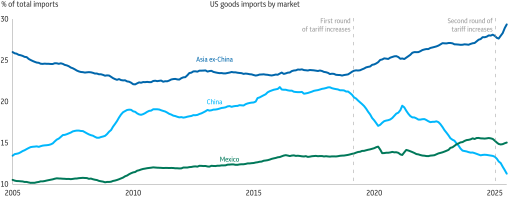
Southeast Asia, Mexico, and southern US markets stand out as key beneficiaries of supply chain evolution, particularly as rising labour costs and tariffs impact manufacturing margins elsewhere. Over the longer term, the Asia-Pacific region will require an estimated one billion square metres of new industrial space to accommodate incremental trade and manufacturing growth, fuelling investment opportunities. 

Figure 5: Shifting trade patterns are impacting logistics and warehousing demand

Source: US Census (November 2025).

David Roberts
Head of Real Estate Strategy 

This information is intended for the audiences as indicated. It is not to be distributed to, or disclosed to retail investors. 

The views expressed in this document represent those of the relevant investment team and are subject to change. No information set out in this document constitutes advice, an advertisement, an invitation, a confirmation, an offer or a solicitation, to buy or sell any security or other financial product or to engage in any investment activity, or an offer of any banking or financial service. Some products and/or services mentioned in this document may not be suitable for you and may not be available in all jurisdictions.

This market commentary has been prepared for general informational purposes by the team, who are part of Macquarie Asset Management (MAM), the asset management business of Macquarie Group (Macquarie), and is not a product of the Macquarie Research Department. This market commentary reflects the views of the team and statements in it may differ from the views of others in MAM or of other Macquarie divisions or groups, including Macquarie Research. This market commentary has not been prepared to comply with requirements designed to promote the independence of investment research and is accordingly not subject to any prohibition on dealing ahead of the dissemination of investment research. 

Nothing in this market commentary shall be construed as a solicitation to buy or sell any security or other product, or to engage in or refrain from engaging in any transaction. Macquarie conducts a global full-service, integrated investment banking, asset management, and brokerage business. Macquarie may do, and seek to do, business with any of the companies covered in this market commentary.

Macquarie has investment banking and other business relationships with a significant number of companies, which may include companies that are discussed in this commentary, and may have positions in financial instruments or other financial interests in the subject matter of this market commentary. As a result, investors should be aware that Macquarie may have a conflict of interest that could affect the objectivity of this market commentary. In preparing this market commentary, we did not take into account the investment objectives, financial situation or needs of any particular client. You should not make an investment decision on the basis of this market commentary. Before making an investment decision you need to consider, with or without the assistance of an adviser, whether the investment is appropriate in light of your particular investment needs, objectives and financial circumstances.

Macquarie salespeople, traders and other professionals may provide oral or written market commentary, analysis, trading strategies or research products to Macquarie’s clients that reflect opinions which are different from or contrary to the opinions expressed in this market commentary. Macquarie’s asset management business (including MAM), principal trading desks and investing businesses may make investment decisions that are inconsistent with the views expressed in this commentary. There are risks involved in investing. The price of securities and other financial products can and does fluctuate, and an individual security or financial product may even become valueless. International investors are reminded of the additional risks inherent in international investments, such as currency fluctuations and international or local financial, market, economic, tax or regulatory conditions, which may adversely affect the value of the investment. This market commentary is based on information obtained from sources believed to be reliable, but we do not make any representation or warranty that it is accurate, complete or up to date. We accept no obligation to correct or update the information or opinions in this market commentary. Opinions, information, and data in this market commentary are as of the date indicated on the cover and subject to change without notice. No member of the Macquarie Group accepts any liability whatsoever for any direct, indirect, consequential or other loss arising from any use of this market commentary and/or further communication in relation to this market commentary. Some of the data in this market commentary may be sourced from information and materials published by government or industry bodies or agencies, however this market commentary is neither endorsed or certified by any such bodies or agencies. This market commentary does not constitute legal, tax accounting or investment advice. Recipients should independently evaluate any specific investment in consultation with their legal, tax, accounting, and investment advisors. Past performance is not indicative of future results.

This market commentary may include forward looking statements, forecasts, estimates, projections, opinions and investment theses, which may be identified by the use of terminology such as “anticipate”, “believe”, “estimate”, “expect”, “intend”, “may”, “can”, “plan”, “will”, “would”, “should”, “seek”, “project”, “continue”, “target” and similar expressions. No representation is made or will be made that any forward-looking statements will be achieved or will prove to be correct or that any assumptions on which such statements may be based are reasonable. A number of factors could cause actual future results and operations to vary materially and adversely from the forward-looking statements. Qualitative statements regarding political, regulatory, market and economic environments and opportunities are based on the team’s opinion, belief and judgment.

Past performance does not guarantee future results.

Diversification may not protect against market risk.

Credit risk is the risk of loss of principal or loss of a financial reward stemming from a borrower’s failure to repay a loan or otherwise meet a contractual obligation. Credit risk arises whenever a borrower expects to use future cash flows to pay a current debt. Investors are compensated for assuming credit risk by way of interest payments from the borrower or issuer of a debt obligation. Credit risk is closely tied to the potential return of an investment, the most notable being that the yields on bonds correlate strongly to their perceived credit risk.

Currency risk is the risk that fluctuations in exchange rates between the US dollar and foreign currencies and between various foreign currencies may cause the value of an investment to decline. The market for some (or all) currencies may from time to time have low trading volume and become illiquid, which may prevent an investment from effecting positions or from promptly liquidating unfavourable positions in such markets, thus subjecting the investment to substantial losses.  

Fixed income securities are subject to credit risk, which is the risk of loss of principal or loss of a financial reward stemming from a borrower’s failure to repay a loan or otherwise meet a contractual obligation. 

Fixed income securities are also subject to interest rate risk, which is the risk that the prices of fixed income securities will increase as interest rates fall and decrease as interest rates rise. 

Interest rate changes are influenced by a number of factors, such as government policy, monetary policy, inflation expectations, and the supply and demand of securities. Fixed income securities with longer maturities or duration generally are more sensitive to interest rate changes. 

Fixed income securities may also be subject to prepayment risk, which is the risk that the principal of a bond that is held by a portfolio will be prepaid prior to maturity at the time when interest rates are lower than what the bond was paying. A portfolio may then have to reinvest that money at a lower interest rate. Infrastructure companies are subject risks including increased costs associated with capital construction programs and environmental regulations, surplus capacity, increased competition, availability of fuel at reasonable prices, energy conservation policies, difficulty in raising capital, and increased susceptibility to terrorist acts or political actions. 

Investment strategies that hold securities issued by companies principally engaged in the infrastructure industry have greater exposure to the potential adverse economic, regulatory, political, and other changes affecting such entities. 

International investments entail risks including fluctuation in currency values, differences in accounting principles, or economic or political instability. Investing in emerging markets can be riskier than investing in established foreign markets due to increased volatility, lower trading volume, and higher risk of market closures. In many emerging markets, there is substantially less publicly available information and the available information may be incomplete or misleading. Legal claims are generally more difficult to pursue. 

Market risk is the risk that all or a majority of the securities in a certain market – like the stock market or bond market – will decline in value because of factors such as adverse political or economic conditions, future expectations, investor confidence, or heavy institutional selling. 

Liquidity risk is the possibility that securities cannot be readily sold within seven days at approximately the price at which a fund has valued them.

A capitalisation rate (cap rate) is a percentage that estimates the potential return on investment for a property. It’s a common metric used in real estate to compare the value of different properties.

Internal rate of return (IRR) is a metric used in financial analysis to estimate the profitability of potential investments. IRR is a discount rate that makes the net present value (NPV) of all cash flows equal to zero in a discounted cash flow analysis. 

Economic trend information is sourced from Bloomberg unless otherwise noted. 

Macquarie Group, its employees and officers may act in different, potentially conflicting, roles in providing the financial services referred to in this document. The Macquarie Group entities may from time to time act as trustee, administrator, registrar, custodian, investment manager or investment advisor, representative or otherwise for a product or may be otherwise involved in or with, other products and clients which have similar investment objectives to those of the products described herein. Due to the conflicting nature of these roles, the interests of Macquarie Group may from time to time be inconsistent with the Interests of investors. Macquarie Group entities may receive remuneration as a result of acting in these roles. Macquarie Group has conflict of interest policies which aim to manage conflicts of interest. 

All third-party marks cited are the property of their respective owners.

Macquarie Asset Management (MAM) is the asset management division of Macquarie Group. MAM is an integrated asset manager across public and private markets offering a diverse range of capabilities, including real assets, real estate, credit, equities and multi-asset solutions.

This information is a general description of Macquarie Asset Management only. The views expressed in this website represent those of the relevant investment team and are subject to change. No information set out above constitutes advice, an advertisement, an invitation, a confirmation, an offer or a solicitation, to buy or sell any security or other financial product or to engage in any investment activity, or an offer of any banking or financial service. Some products and/or services mentioned on this website may not be suitable for you and may not be available in all jurisdictions.

Investing involves risk including the possible loss of principal. The investment capabilities described in this website involve risks due, among other things, to the nature of the underlying investments. All examples herein are for illustrative purposes only and there can be no assurance that any particular investment objective will be realized or any investment strategy seeking to achieve such objective will be successful.

Past performance is not a reliable indication of future performance.

Before acting on any information, you should consider the appropriateness of it having regard to your particular objectives, financial situation and needs and seek advice.

Other than Macquarie Bank Limited ABN 46 008 583 542 (“Macquarie Bank”), any Macquarie Group entity noted in this website is not an authorized deposit-taking institution for the purposes of the Banking Act 1959 (Commonwealth of Australia).  The obligations of these other Macquarie Group entities do not represent deposits or other liabilities of Macquarie Bank.  Macquarie Bank does not guarantee or otherwise provide assurance in respect of the obligations of these other Macquarie Group entities.  In addition, if this website relates to an investment, (a) the investor is subject to investment risk including possible delays in repayment and loss of income and principal invested and (b) none of Macquarie Bank or any other Macquarie Group entity guarantees any particular rate of return on or the performance of the investment, nor do they guarantee repayment of capital in respect of the investment.


Unlocking alpha in disruptive times
Explore the full report to see our views on the year ahead.